
Listening to the Individual // Working with an Aging Cassowary
Some training projects begin with a clear plan, whilst others slowly reveal themselves as you go.
Working with Chook, an ageing Southern Cassowary, became one of those projects. What began as a straightforward attempt to condition a bird to step onto scales and load into a crate gradually turned into something else entirely. An exercise in listening closely to the individual in front of me.
The original goal was fairly simple. Reliable weight monitoring to support veterinary care and, ideally, a voluntary crate load for transport in preparation for off site diagnostic imaging and ongoing health monitoring. As is often the case when working with animals though, the process quickly became less about the plan and more about listening carefully to the individual in front of me.
Chook is an ageing bird with known mobility challenges, including previous toe amputations that affect both balance and weight distribution. He has also lived his entire life with a slightly deformed beak, and ongoing ocular concerns meant a CT scan needed to be performed off site, making low stress transport an important priority.
Training began with simple target work to establish clear communication. Chook was curious and readily engaged.
During early sessions, however, I began noticing occasional head shaking following contact with the target. The original target was a hard plastic ball, and the behaviour suggested the contact might be uncomfortable.
I switched to a softer tennis ball target and saw an immediate improvement in Chook’s responses. Over time it also became clear that he did not necessarily need the target at all. Chook oriented readily to people, recalled well, and was highly responsive to subtle bodily cues. Eventually the target faded out of the training entirely.
It was a useful reminder that sometimes the tools we start with are only temporary bridges. When the animal shows us a clearer path, it often makes sense to follow it.
Scale Training
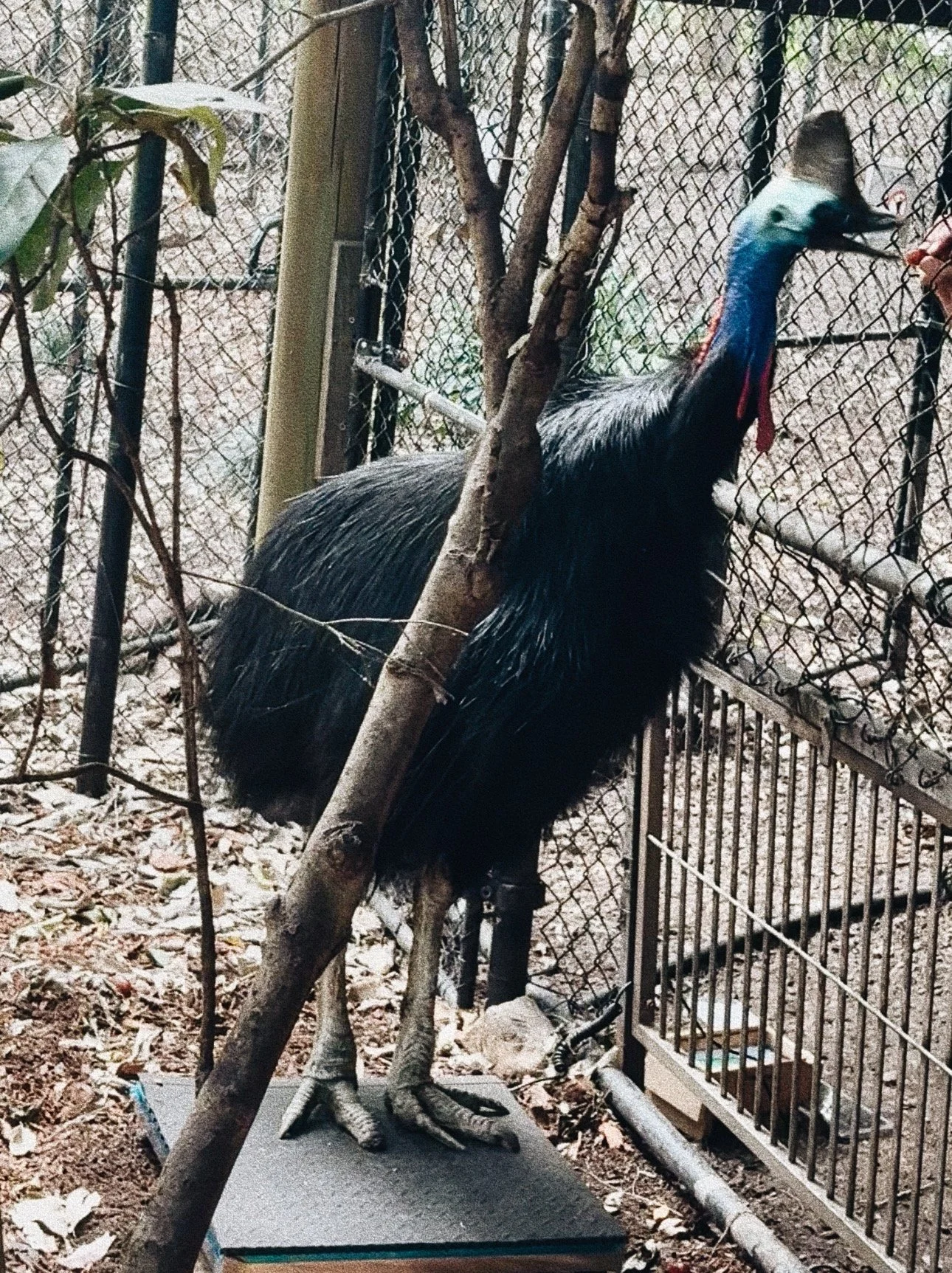
Scale conditioning began on a station mat before transferring the behaviour onto the scales themselves.
Chook progressed steadily, but the scale platform, only about seventy millimetres high, proved more challenging than expected. Stepping on and off occasionally caused him to stumble, likely influenced by the altered stability that comes with toe loss and an ageing body.
Slowing the pace of training and allowing him time to place his feet deliberately made a noticeable difference. As his confidence improved, he became increasingly comfortable stepping up and stationing on the scales.
Over time this has developed into reliable voluntary scale behaviour, allowing us to obtain regular weights without restraint. For an ageing bird like Chook, this has become an important part of his ongoing management. Subtle changes in body weight can often provide one of the earliest indicators of shifting health, and being able to monitor that through voluntary participation keeps the process calm and low stress for him.
Adapting the Environment
Around the same time, via daily observations, I noticed Chook was showing reluctance to cross a shallow creek within the enclosure. The uneven substrate appeared to affect both balance and confidence.
Rather than shaping him through the crossing, the environment itself was reconsidered.
A simple mulch bridge was installed to create a more stable surface. The change was immediate. Chook crossed confidently and began moving through the enclosure with far greater ease. It was a small modification, but it significantly reduced the risk of stumbles and helped restore his confidence moving around the habitat.
Moments like this highlight how strongly enclosure terrain can influence participation and welfare, particularly for animals managing physical limitations.
Working Within Reality
A transport crate was obtained and a training chute and loading area were set up to allow gradual familiarisation.
Crate conditioning began with voluntary approach and investigation, followed by reinforcement for proximity and partial entry. Chook showed strong interest in the crate and remained engaged through the early stages of training, though progress was slow for understandable reasons.
Chook is managing several physical challenges. His vision is affected by cataracts, which makes dark or enclosed spaces more difficult to assess, and the small step up into the crate occasionally challenged his balance.
Rather than rushing the behaviour, the focus remained on allowing him time to investigate and build confidence around the structure.
Of course, training rarely unfolds in a perfectly controlled environment. Many of our earlier sessions took place during mid afternoon, which coincided with peak guest activity. Increased noise and movement around our training area noticeably affected Chook’s focus and willingness to participate.
Shifting training sessions to the quieter period before park opening made a significant difference and allowed him to engage more consistently.
The crate itself also required several modifications along the way, including the addition of a secondary mesh panel so reinforcement could continue to be delivered during conditioning, and then structural repairs and adjustments created further interruptions to the training timeline.
So progress continued, but not always smoothly.
As often happens in zoo environments, operational timelines eventually caught up with the training process. The scheduled CT date arrived before crate conditioning could be fully completed.
Transport Day
By the time transport day arrived, the final set up differed slightly from the arrangement we had been training with.
Operational requirements meant the team ultimately used a chute system to guide Chook toward the crate, altering the antecedents once again. Situations like this are not uncommon when working within the practical realities of animal management and veterinary timelines.
Although full crate conditioning had not been completed, Chook had developed familiarity with several key elements of the process. He was comfortable moving through the chute space, investigating and partially stepping inside the crate structure, and participating in training sessions around the loading area.
That prior exposure appeared to make a difference on the day. Chook showed relatively little hesitation and was successfully loaded for transport.
He was then transported off site for CT imaging to investigate the ongoing ocular concerns.
Looking Back
Working with an ageing cassowary like Chook reinforced something that many trainers eventually learn.
Training is rarely just about shaping behaviour.
It is about recognising physical limitations, adjusting environments, and responding to the feedback an animal offers along the way.
In Chook’s case, small changes made meaningful differences.
A softer target improved comfort and engagement.
Slowing scale training supported balance and confidence.
A simple mulch bridge restored mobility within the enclosure.
Familiarity with the crate and training area eased transport despite time constraints.
Each adjustment came from observation rather than expectation.
Crate conditioning itself was never fully completed before the scheduled veterinary procedure. Some might view that as failure or unfinished work.
I do not see it that way.
Training does not always move according to the timeline we set. Animals, especially ageing ones, often ask us to move at a different pace. Sometimes the most respectful choice is simply to take the time it takes, adapting the process as new information emerges.
Often the most valuable thing training reveals is not the behaviour we originally set out to teach, but what the animal needs from us in order to participate at all.